What Happens Inside a Cash Counting Machine? The Technology Behind Every Count

Buying a Cash Counting Machine? 7 Things You Should Check First
September 19, 2026
Cash Counting Machines for Retail Stores: Faster and Easier Cash Handling
September 28, 2026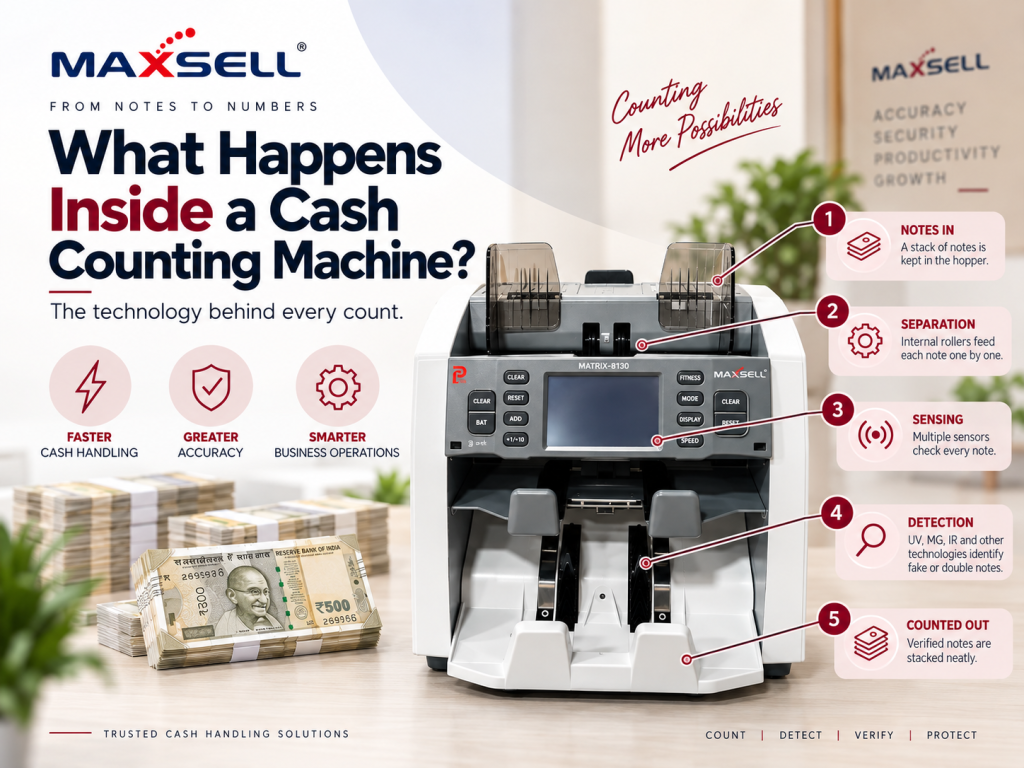
What Happens Inside a Cash Counting Machine? The Technology Behind Every Count
It’s different from the usual “5 benefits / buying guide / why you need a machine” content.
The article could open with:
You put a stack of notes into a cash counting machine, press a button, and within seconds a number appears on the display.
But how does the machine actually know that it has counted 97, 98 or 100 notes?
And how can it detect when two notes have entered together?
The answer isn’t simply “because it’s automatic.”
Inside that compact machine is a combination of note-feeding mechanisms, sensors, detection systems and electronic processing working together in fractions of a second.

Then structure it around:
1. Step 1 — Feeding the notes
How the hopper and feeding mechanism move notes into the machine.
2. Step 2 — Separating the notes
How the machine attempts to feed individual notes rather than an entire stack.
3. Step 3 — Sensing every note
How sensors detect notes as they pass through.
4. Step 4 — Detecting double notes
Why two notes entering together can create a counting problem and how detection mechanisms help identify abnormal feeding.
5. Step 5 — Counting the notes
How each detected note contributes to the displayed count.
6. Step 6 — Authentication checks
Where UV/MG/IR or other detection technologies come into the process, depending on the machine.
7. Step 7 — Stacking the notes
How counted notes are collected for easy verification and handling.
8. Why maintenance matters
Dust, worn rollers, sensors and note condition can affect machine performance.
9. What the number on the display actually means
A useful distinction between piece count, value count, and detected errors.
10. Final takeaway
A cash counting machine isn’t simply “counting faster.” It’s automating several steps of a repetitive cash-handling process.