Cash Counting Machines: Understanding the Technology, Types, Working Principles and Role in Modern Cash Management

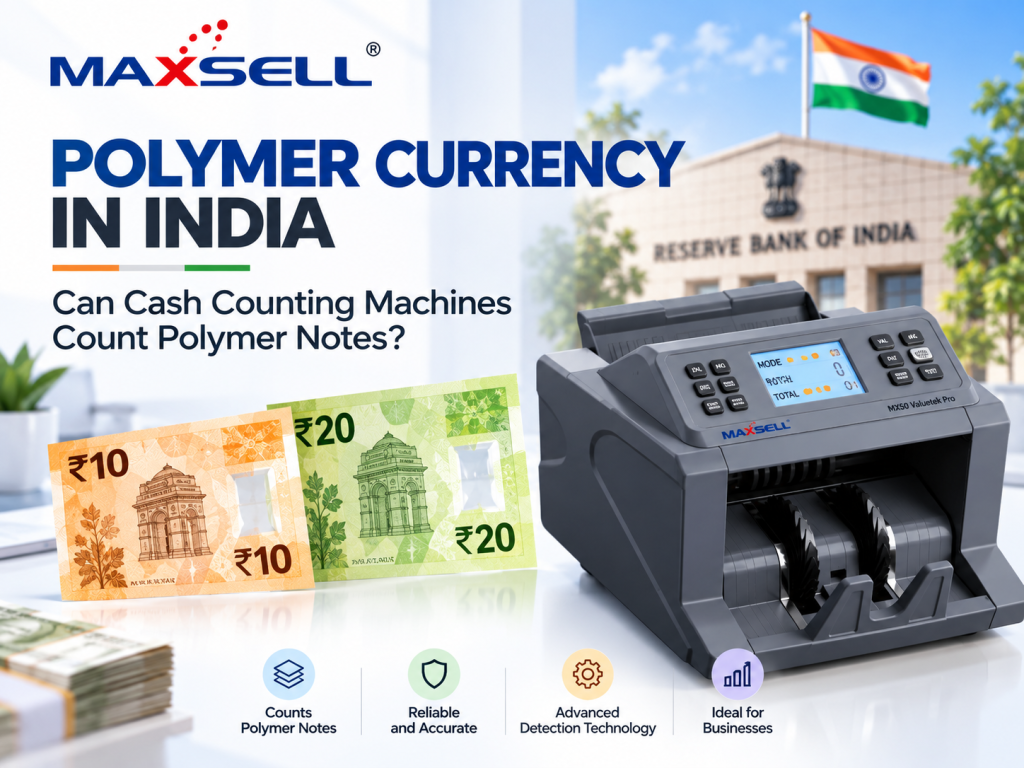
Polymer Currency Notes in India: Can Maxsell Cash Counting Machines Count Polymer Notes?
October 24, 2026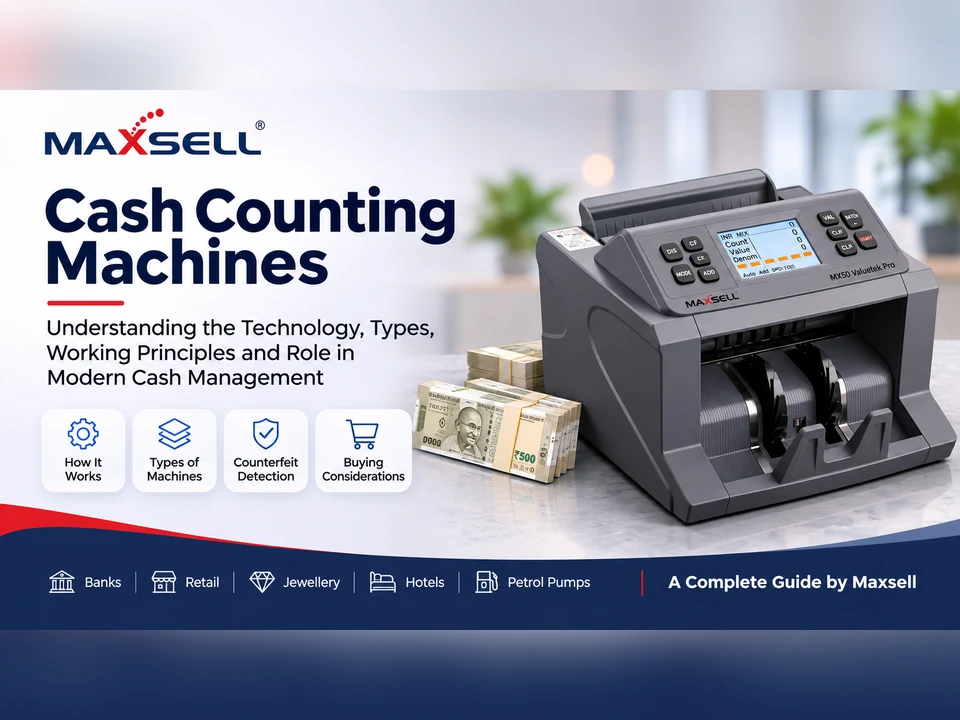
Cash Counting Machines: Understanding the Technology, Types, Working Principles and Role in Modern Cash Management
Category: Cash Management Technology
Primary Topic: Cash Counting Machines
Content Type: Educational / Technical Guide
Last Updated: November 2026
1. What Is a Cash Counting Machine?
A cash counting machine is an electronic device designed to count currency notes automatically. Depending on its technology and configuration, it may also identify denominations, calculate total monetary value, detect potentially suspicious banknotes and sort notes according to specified characteristics.
Cash counting machines are used by banks, financial institutions, retail businesses, jewellery stores, supermarkets and other organisations that handle physical currency.
The primary purpose of these machines is to automate repetitive cash-counting operations, improve processing efficiency and support more consistent cash management.
However, not all cash counting machines perform the same functions. A basic note counter, a mixed-denomination value counter and a banknote sorting machine are designed for different operational requirements.
Understanding these differences is important when evaluating currency-processing technology.
2. How Does a Cash Counting Machine Work?
A cash counting machine operates through a combination of mechanical components, electronic sensors and processing systems.
The general working process involves five stages:
Stage 1: Note Feeding
Currency notes are placed in the machine’s hopper. The feeding mechanism moves the notes into the internal counting system.
Stage 2: Note Separation
A mechanical feeding arrangement separates notes and guides them through the machine individually.
Stage 3: Note Detection
Electronic sensors detect the movement and relevant characteristics of the notes. Depending on the machine, these may include optical, magnetic, ultraviolet, infrared or image-based sensing technologies.
Stage 4: Data Processing
The machine’s electronic processing system interprets sensor information and performs the functions supported by its configuration, such as note counting, denomination recognition or suspicious-note detection.
Stage 5: Result Display
The machine displays the counting results. Advanced models may also provide denomination-wise totals, batch information, error alerts and other processing details.
The exact working mechanism varies according to the machine’s design and capabilities.
3. What Are the Different Types of Cash Counting Machines?
Cash counting machines can be classified according to the functions they perform.
A. Basic Note Counting Machines
Basic note counting machines calculate the number of currency notes passing through the machine.
They are primarily designed for quantity-based counting rather than identifying the monetary value of mixed denominations.
Typical applications include:
- Retail cash counters
- Small businesses
- Daily cash reconciliation
- General cash-handling operations
B. Value Counting Machines
Value counting machines identify supported currency denominations and calculate the total monetary value of processed notes.
For example, a machine that supports mixed-denomination counting may identify ₹100, ₹200 and ₹500 notes and calculate their combined value.
This reduces the need for manual denomination-wise calculations.
C. Mixed-Denomination Counting Machines
Mixed-denomination machines are designed to process different denominations together rather than requiring the operator to separate every denomination before counting.
Depending on the model, they can provide:
- Total note count
- Denomination-wise count
- Total monetary value
- Suspicious-note alerts
D. Currency Sorting Machines
Currency sorting machines perform more advanced banknote-processing operations.
Depending on their configuration, they may classify notes by denomination, orientation, fitness or other supported characteristics.
They are particularly relevant to banks, currency chests and large cash-processing environments.
4. Understanding the Technologies Used in Cash Counting Machines
Modern banknote-processing equipment uses different sensing and detection technologies.
Understanding these technologies helps explain how machines examine currency notes.
4.1 Ultraviolet (UV) Detection
Ultraviolet detection uses UV light to examine specific security features in banknotes.
Certain security elements respond to ultraviolet illumination in characteristic ways.
UV-based detection is used in some currency verification systems to support the identification of suspicious notes.
4.2 Magnetic (MG) Detection
Magnetic detection examines magnetic properties associated with specific security features in banknotes.
The machine uses magnetic sensors to identify relevant signals and compare them with expected characteristics.
Its effectiveness depends on sensor configuration and the supported currency.
4.3 Infrared (IR) Detection
Infrared detection uses infrared light and sensors to examine how different areas of a banknote respond to infrared illumination.
Certain printing features and security elements can exhibit distinctive infrared characteristics.
IR technology can therefore contribute to banknote authentication.
4.4 Image-Based Detection
Advanced banknote-processing machines may use image sensors and image-processing systems to examine visual characteristics of currency notes.
Depending on the system, image analysis may support:
- Denomination recognition
- Note orientation detection
- Identification of damaged notes
- Recognition of specific printed features
- Banknote classification
The technologies available differ considerably between basic counters and advanced sorting systems.
Important: No single detection technology should be assumed to guarantee that a banknote is genuine. Authentication depends on the complete detection system, its calibration, supported currency specifications and applicable testing standards.
5. What Is the Difference Between Counting, Value Counting and Sorting?
These three functions are often confused, but they represent different levels of currency processing.
| Function | Primary Purpose |
|---|---|
| Note Counting | Calculates the number of notes |
| Value Counting | Identifies supported denominations and calculates monetary value |
| Note Sorting | Separates and classifies notes according to supported criteria |
For example, a basic counter can report that 500 notes have been processed.
A value counter can potentially report how many ₹100, ₹200 and ₹500 notes were processed and calculate their combined value.
A sorting machine can additionally separate notes according to its supported sorting parameters.
These capabilities should not be treated as interchangeable.
6. What Is Counterfeit Note Detection in Cash Counting Machines?
Counterfeit note detection refers to the examination of banknotes using sensors and verification technologies to identify notes that may have suspicious or inconsistent characteristics.
Modern machines may use a combination of detection methods rather than relying on a single sensor.
In India, the Reserve Bank of India provides instructions concerning the detection and handling of counterfeit notes by banks.
Its Master Direction on Counterfeit Notes, 2025, addresses the use of note sorting and authentication machines and specifies relevant requirements for banking operations.
The RBI also refers to Note Authentication and Fitness Sorting Parameters and applicable Bureau of Indian Standards certification requirements.
These requirements are particularly relevant when evaluating banknote-processing equipment for institutional applications.
7. Why Are Cash Counting Machines Important for Banks and Businesses?
Cash counting machines support several operational requirements.
Operational Efficiency: Automated counting reduces the time spent on repetitive manual counting.
Cash Reconciliation: Counting results can support daily cash verification and reconciliation procedures.
Reduced Manual Workload: Employees spend less time performing repetitive counting tasks.
Denomination Management: Supported value-counting machines help organise cash according to denomination.
Cash Verification: Machines with appropriate authentication features can assist in identifying potentially suspicious notes.
High-Volume Processing: Advanced equipment can support organisations that process substantial quantities of banknotes.
8. Where Are Cash Counting Machines Used?
Cash counting technology has applications across multiple sectors.
| Sector | Common Application |
|---|---|
| Banking | Cash counting, verification and processing |
| Jewellery | Daily cash collection and reconciliation |
| Retail | Cash counter management |
| Supermarkets | High-volume cash handling |
| Financial Institutions | Currency collection and processing |
| Hotels | Cash reconciliation |
| Petrol Pumps | Daily cash verification |
| Currency Chests | Large-scale banknote processing and sorting |
The required machine configuration depends on the volume of currency, processing frequency and operational requirements of each sector.
9. What Factors Should Be Considered When Evaluating a Cash Counting Machine?
Selecting currency-processing equipment requires more than comparing counting speeds.
The following technical and operational factors should be considered:
- Counting Speed: The number of notes processed per minute under specified operating conditions.
- Currency Compatibility: Whether the machine supports the required currency and denominations.
- Denomination Recognition: Whether mixed-denomination identification is supported.
- Authentication Technology: Which verification sensors and detection capabilities are included?
- Sorting Functionality: Whether the machine can classify notes according to the required parameters.
- Hopper and Stacker Capacity: The quantity of notes that can be accommodated.
- Error Detection: Whether the machine identifies feeding errors, double notes or other processing issues.
- Maintenance Requirements: Cleaning, calibration and servicing requirements.
- Operational Environment: Whether the equipment is suitable for the intended daily workload.
A machine should be evaluated against the actual cash-processing requirements of the organisation.
10. Cash Counting Machines and the Future of Cash Management
Although digital payments continue to expand, physical currency remains relevant across many business environments.
Banks, retailers, financial institutions and cash-intensive organisations still require efficient methods to process, verify and reconcile banknotes.
Modern currency-processing equipment is evolving through improved sensing systems, image recognition, automated denomination identification and more advanced sorting capabilities.
These developments are helping organisations move from manual cash handling towards more structured and automated currency-management processes.
The future of cash management will depend not only on faster counting but also on reliable authentication, accurate classification, operational efficiency and integration with wider financial processes.
11. Frequently Asked Questions About Cash Counting Machines
What is the difference between a cash counting machine and a currency counting machine?
The terms are commonly used interchangeably. Both generally refer to equipment designed to count banknotes, although specific machine capabilities vary.
Can a cash counting machine count mixed denominations?
Yes, certain models support mixed-denomination recognition and value calculation. Basic note counters may only calculate the total number of notes.
How does a cash counting machine detect fake notes?
Depending on the model, it may use UV, magnetic, infrared, image-based or other sensing technologies to examine banknote characteristics.
Does every cash counting machine detect counterfeit currency?
No. Basic counting machines may only count notes. Authentication capabilities are available only in machines designed and equipped for those functions.
What is a currency sorting machine?
A currency sorting machine is equipment designed to classify and separate banknotes according to supported parameters, such as denomination, orientation or fitness.
What is batch counting?
Batch counting allows an operator to count notes in predetermined quantities, such as 50, 100 or 200 notes.
What is the add function in a cash counting machine?
The add function combines multiple counting sessions to calculate a cumulative count or value, depending on the machine.
Are cash counting machines used in banks?
Yes. Banks use note counting and note sorting/authentication equipment for different cash-processing requirements.
What is the difference between note fitness sorting and counterfeit detection?
Counterfeit detection examines banknotes for characteristics associated with authenticity. Fitness sorting classifies notes according to their physical condition and suitability for further circulation.
These are separate processing functions, although advanced machines may support both.
Conclusion
Cash counting machines are an important part of modern cash-management infrastructure. Their capabilities range from basic note counting to denomination recognition, authentication and advanced currency sorting.
Understanding the technology, operating principles and differences between machine categories helps businesses and financial institutions make informed decisions about cash-processing systems.
As cash-handling requirements evolve, accurate counting, reliable verification and efficient sorting will continue to play important roles in currency management.
About Maxsell
Maxsell works in the cash-handling automation and currency-processing equipment space, offering solutions for organisations with different cash-management requirements.
Explore the company’s technical resources and product information at https://maxsell.tech.
References and further reading
- Reserve Bank of India – Master Direction on Counterfeit Notes, 2025: https://www.rbi.org.in/scripts/BS_ViewMasDirections.aspx?id=13361
- Reserve Bank of India – Currency Management and Banknote Information: https://www.rbi.org.in/
This article is intended for educational purposes. Machine capabilities, authentication performance and applicable standards should always be verified against the specifications and certification documentation of the individual equipment.