Cash Counting Machine: Manual vs Machine Cost & Error Guide

What should you check Before Buying a Cash Counting Machine in India | Maxsell
April 7, 2026
Cash Counting Machine: A Simple Guide for Businesses
September 16, 2026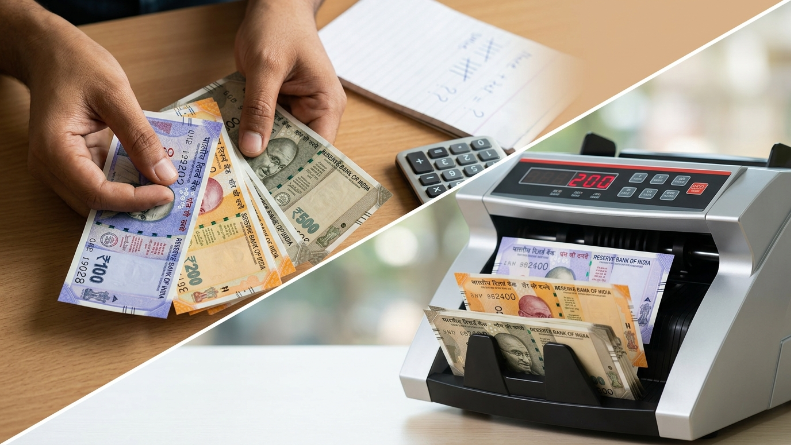
Short Summary
If you’re still counting cash manually in 2026, you’re losing money. A cash counting machine processes thousands of notes in minutes while manual counting takes hours and creates errors. Businesses using currency counters report 99.9% accuracy compared to 95% with human counting. Machine counting wins on cost, speed, and accuracy every time when you factor in labor, mistakes, and time wasted.
TL;DR
- Manual cash counting is slow, error-prone, and expensive when calculating labor costs and mistakes
- A cash counting machine processes 1,000 bills in under 60 seconds vs 15-20 minutes manually
- Human error rate sits around 1-5%, while money counting machines deliver 99.9% accuracy
- Investment in a currency counter pays back within 3-6 months for most businesses
- Fake note detection comes standard, something humans often miss
- Maxsell provides high-performance cash counting machines designed for efficiency, accuracy, and long-term reliability for banks and businesses across India
Introduction
In 2026, thousands of businesses still count cash by hand. One note at a time. That’s costing them far more than they realize.
If you run a retail store, restaurant, bank branch, or any business handling physical currency, you’ve faced this problem. Your cashier spends 30 minutes counting the day’s earnings, then recounts because numbers don’t match. Before you know it, you’ve spent an hour on something a cash counting machine could’ve done in two minutes.
The debate between manual and machine counting isn’t about tradition versus technology. It’s about money, time, and accuracy. When handling lakhs of rupees daily, even a 1% error rate becomes massive. A misplaced hundred-rupee note here, a miscounted stack there, and your books don’t balance.
Here’s what most don’t consider: labor costs. If you’re paying someone ₹20,000 monthly and they spend two hours daily counting cash, that’s roughly ₹5,000 worth of time spent just counting money. Every month. Annually, that’s ₹60,000 on an activity that doesn’t generate revenue.
Modern currency counting machines have changed completely. Today’s note counting machines are compact, affordable, and easy to use. They detect fake notes, sort denominations, and connect to accounting software.
This blog breaks down everything you need to know. We’ll compare costs, error rates, time investment, and long-term value. If you’re looking for reliable equipment, check out Maxsell’s currency counters – they’ve been helping businesses across Tamil Nadu streamline cash operations for years.
The Real Cost of Manual Cash Counting
Manual cash counting costs go far beyond salary. The real cost sits hidden in places most business owners never look.
Direct labor cost first. If your cashier earns ₹18,000 monthly and spends 90 minutes daily counting cash, that’s 11% of working hours. That translates to roughly ₹2,000 monthly spent purely on counting money. But manual counting requires at least two people for verification in most businesses. Now you’re looking at double that investment.
Error cost is significant. Reserve Bank of India studies show manual cash handling has an average error rate between 1-5%. A medium-sized retail store handling ₹2 lakh daily might see errors of ₹2,000 to ₹10,000 weekly. That’s real money disappearing into counting mistakes.
Opportunity cost matters. While your best employee counts notes, they’re not doing higher-value work. They’re not training staff, improving customer experience, or handling complex transactions. A cash counting machine frees up skilled labor for tasks that actually grow your business.
Theft and discrepancies create gaps where money can go missing. Manual counting lacks audit trails, making it impossible to pinpoint where shortages occurred. Was it counting error? Customer dispute? Internal theft? You’ll never know.
Physical toll includes fatigue, eye strain, and repetitive stress injuries. A tired employee makes more mistakes, creating a vicious cycle. Currency notes also carry bacteria and viruses – manual counters touch thousands of potentially contaminated notes daily.
Training cost adds up. Every new hire needs to learn cash handling procedures, practice counting accurately, and understand verification protocols. With a money counting machine, training takes 15 minutes.
When you add everything – direct labor, errors, opportunity cost, theft risk, health concerns, and training – manual counting becomes surprisingly expensive. Most businesses spend 3-5 times more than they think. A professional cash counting machine eliminates almost all these hidden costs.
Speed Comparison Facts
A skilled manual counter processes 60-80 notes per minute when fresh and focused. For 1,000 notes, that’s 12-16 minutes minimum. In actual working conditions with worn notes, distractions, and recounts, it takes 20-25 minutes. For 5,000 notes daily, you’re spending nearly two hours.
A currency counting machine processes 800-1,000 notes per minute. High-end models hit 1,500 notes per minute. That same 1,000-note stack? Done in 60 seconds. The 5,000-note daily collection? About 5 minutes total.
Speed isn’t just counting itself. Manual counting requires stacking, sorting, bundling, and verification. With a note counting machine, you load notes, press start, and the machine counts, sorts, detects fakes, and prints reports.
A Chennai retail chain switched from manual to machine counting. Before, end-of-day settlement took three people 90 minutes. After installing a cash counting machine, one person finishes in 15 minutes. That’s 83% time reduction.
Banks processing 50,000+ notes daily see even bigger improvements. Manual counting would require a dedicated team working non-stop. With heavy duty cash counters, they process the same volume in a fraction of time with one or two operators.
Manual counting speed decreases over time. After an hour of repetitive counting, speed drops. A bill counter machine counts note 10,000 at exactly the same speed as note one.
Speed Metrics:
- Manual counting: 60-80 notes/minute (ideal), 40-50 notes/minute (realistic)
- Basic currency counter: 800-1,000 notes/minute
- Professional cash counting machine: 1,200-1,500 notes/minute
- Bank-grade counters: 1,800+ notes/minute
The speed advantage is overwhelming. What takes hours manually takes minutes with machines.
Error Rates and Accuracy
Manual cash counting has an error rate between 1-5% under normal conditions. A business processing ₹5 lakh daily with 2% error rate faces potential discrepancies of ₹10,000 daily. That’s ₹3 lakh monthly in counting errors.
Error types include simple miscounts, denomination mixing, orientation errors, and accepting counterfeits. Fatigue dramatically increases errors – rates climb from 1% in the first hour to 3-4% after three hours of continuous counting.
Environmental factors matter. Poor lighting increases errors by 40%. Background noise and distractions add another 30%. Psychological pressure ironically increases mistakes.
Manual counting lacks verification mechanisms. Unless you count twice (doubling time), you’re trusting one person’s count. When discrepancies appear, there’s no way to know where the error occurred.
Counterfeit detection through manual methods is unreliable. Even trained bank tellers miss sophisticated fakes. The human eye can’t always catch security features, especially under time pressure.
Modern currency counting machines have error rates below 0.01%. That’s one error in 10,000 notes. The machine doesn’t get tired, distracted, or stressed.
Built-in sensors verify every note. UV detection, magnetic ink sensing, infrared scanning, and size verification happen simultaneously at counting speed. A cash counting machine catches fakes that humans miss 95% of the time.
Accuracy Metrics:
- Human error rate: 1-5%
- Machine error rate: <0.01%
- Fake note detection (human): 60-80% accuracy
- Fake note detection (machine): 98-99.5% accuracy
- Fatigue impact on humans: 300% error increase
- Fatigue impact on machines: Zero
For businesses where precision matters, a professional cash counting machine eliminates uncertainty that comes with manual counting. Maxsell’s service options ensure your machine maintains peak accuracy over time.
Investment vs Savings Analysis
A basic money counter for small businesses starts around ₹8,000-₹15,000. Mid-range currency counters with fake note detection run ₹25,000-₹45,000. High-end banking machines cost ₹60,000-₹1,50,000.
Real example: A retail store handling ₹3 lakh daily, employing one person at ₹20,000 monthly who spends 2 hours daily counting. That’s ₹5,000 monthly in direct labor. Add 1.5% error rate on ₹90 lakh monthly, potential losses of ₹1,35,000 monthly from counting mistakes.
Conservatively estimate 30% of errors slip through. That’s ₹40,500 monthly in undetected errors. Add labor cost of ₹5,000, total ₹45,500 monthly spent on manual counting.
Buy a ₹35,000 cash counter. Payback period? Less than one month. After that, you’re saving ₹45,500 monthly. Annually, that’s ₹5,46,000 in savings. Over five years, you’ve saved ₹27,30,000 from a ₹35,000 investment.
You’ve also freed up 60 hours monthly of employee time for productive work. If that increases sales by even 2%, that’s another ₹1,80,000 annually.
For higher-volume businesses, banks processing crores daily see payback periods measured in days. Maintenance costs are minimal – quality note counting machines require basic cleaning and occasional servicing.
A well-maintained currency counter lasts 5-10 years. Spread ₹35,000 over seven years, that’s ₹5,000 annually. Meanwhile, manual counting costs ₹5,46,000 annually. Every year.
ROI Metrics:
- Initial cost: ₹8,000 to ₹1,50,000
- Monthly manual counting cost: ₹45,000-₹1,50,000
- Typical payback period: 1-6 months
- Annual savings: ₹5,00,000-₹18,00,000
- Machine lifespan: 5-10 years
- Maintenance cost: ₹5,000-₹15,000 annually
The math is clear. Manual counting is an ongoing expense that never stops. A cash counting machine is a one-time investment that saves money immediately and continuously.
Counterfeit Detection Capabilities
Fake currency is a real problem. RBI estimates that for every 1 million notes in circulation, 1-2 are counterfeit. When handling lakhs of notes monthly, the probability of encountering fakes shoots up dramatically.
Manual counterfeit detection relies on checking watermark, security thread, paper feel, maybe hologram. Problem is, counterfeiters know what cashiers check. Studies show manual inspection catches only 60-70% of counterfeits.
The human eye can’t see UV features, detect magnetic ink variations, measure exact dimensions, or analyze infrared signatures. These security features exist specifically because they’re machine-detectable, not human-detectable.
Modern currency counting machines with fake note detection scan every note across multiple parameters simultaneously:
- UV light detection for security features
- Magnetic ink detection for authentic printing patterns
- Infrared scanning for paper composition
- Size and thickness verification
- Multi-point scanning for printing quality
This happens at counting speed. The machine examines 1,000 notes per minute with the same thoroughness. When a suspicious note appears, the machine stops immediately and flags it for verification.
A Chennai jewellery shop owner installed a money counter device two years ago mainly for speed. Unexpected benefit? It caught eleven counterfeit notes in the first month that experienced staff had accepted. That’s ₹5,500 in losses prevented immediately.
Detection Metrics:
- Manual fake detection accuracy: 60-75%
- Machine fake detection accuracy: 98-99.5%
- Manual verification time: 5-10 seconds per note
- Machine verification: 0.06 seconds per note
The protection a bill counter machine provides extends beyond catching fakes. It protects your reputation. The best cash counting machine for your business should always include multi-level counterfeit detection.
Labor and Operational Efficiency
Manual cash counting isn’t a one-person job. You need verification and cross-checking. The cashier counts, supervisor recounts to verify, and in larger operations, accounts does final verification. That’s three people spending time on the same task.
Each verification level takes almost as long as initial count. If counting takes 30 minutes, verification takes 25 minutes, final check takes 20 minutes. You’re looking at 75 minutes of combined labor.
Banks have elaborate procedures. Teller counts, head teller verifies, branch manager spot-checks, vault custodian does another count. A branch handling ₹50 lakh daily might have four people spending three hours each on counting. That’s twelve labor hours daily.
Calculate the cost. Four employees at ₹25,000 monthly. 360 hours is roughly 45 working days. That’s 1.5 employees fully dedicated to counting, or ₹37,500 monthly in labor just for cash counting.
With a professional cash counting machine, one person completes the entire process. No verification needed because the machine provides accurate counts with printed records. What took twelve labor hours now takes one.
Training new staff on manual counting takes days or weeks. Training someone to use a note counting machine? Fifteen minutes. Load notes, press button, remove counted notes, check display. Done.
Labor Metrics:
- Manual counting labor requirement: 2-4 people per session
- Machine counting labor requirement: 1 person
- Manual training time: 5-10 days
- Machine operation training: 15-30 minutes
For businesses in Tamil Nadu where labor costs are rising, reducing labor-intensive processes makes business sense. A heavy duty cash counter lets you maintain operations with leaner teams without sacrificing accuracy.
Time-to-Settlement and Business Impact
End-of-day settlement is when you count everything, reconcile records, and secure cash. In manual operations, this drags on forever.
A medium-sized retail store with three registers takes 90-120 minutes for complete settlement. For bank branches, settlement is more complex. Multiple tellers, vault cash, ATM replenishment all need counting. Manual settlement in busy branches takes three to four hours. Staff scheduled till 5 PM often leave at 8 or 9 PM.
This overtime is hidden cost. If settlement takes two extra hours daily, that’s ten hours weekly. At time-and-a-half overtime rates, you’re paying significant premiums.
A cash counting machine transforms settlement speed. What took 90 minutes manually takes 20 minutes with machine. You’re reducing settlement time by 75-80%. Staff leave on schedule. Overtime costs disappear.
Bank branches using professional currency counting machines report settlement times reduced by 60-70%. A process taking four hours now takes 90 minutes.
Faster settlement means faster deposits. Cash sitting overnight is a security risk. Quicker verification and bundling means lower exposure to theft.
Settlement Metrics:
- Manual settlement (small business): 60-90 minutes
- Machine settlement (small business): 15-20 minutes
- Manual settlement (bank): 3-4 hours
- Machine settlement (bank): 60-90 minutes
- Overtime cost reduction: 75-80%
The time savings compound over weeks and months. Twenty minutes saved daily equals 120 hours saved annually per location. For a chain with ten locations, that’s 1,200 labor hours returned for productive use.
Scalability for Growing Businesses
When businesses grow, manual counting becomes exponentially more difficult. Start with a shop handling ₹50,000 daily – one person counts it in 45 minutes. Business grows to ₹2 lakh daily, same person needs three hours. You’re approaching a breaking point.
Growth to ₹5 lakh daily? Now you need specialized cash management, possibly multiple counting shifts, elaborate verification procedures.
A money counter device scales effortlessly. Whether processing ₹50,000 or ₹50 lakh, the machine counts at the same speed. The same machine that served your startup serves your expanded operation years later.
Seasonal variations create similar challenges. Retail businesses see 2-3x volume during festivals. Manual counting teams can’t suddenly triple their speed. With a currency counting machine, seasonal spikes are handled by same equipment and operator.
Geographic expansion brings complexity. Opening second or third location means replicating entire manual counting infrastructure. Equip each location with a banknote counter and the process standardizes.
Scalability Metrics:
- Manual counting scalability: Limited, requires proportional labor increase
- Machine counting scalability: Excellent, same equipment handles higher volumes
- Cost increase with growth (manual): 100-200%
- Cost increase with growth (machine): 0-10%
For businesses planning expansion or experiencing rapid growth, investing in professional-grade equipment from the start makes sense. Maxsell’s consultation services help businesses assess current and projected needs.
Security and Audit Trail Benefits
Cash handling security is about accountability, audit trails, and tracking every rupee. Manual counting creates accountability gaps. When shortages appear, pinpointing where the error occurred is nearly impossible.
A currency counting machine creates immediate audit trail. The machine prints report: date, time, operator, denomination, quantity, total value. If shortage appears, you trace it to specific counting sessions.
Operator accountability improves. When each count is machine-verified and documented, errors and manipulation both decrease. Everyone knows the machine creates records for audit anytime.
Manager oversight requires less time. Instead of personally supervising counting, managers review machine-generated reports. They focus on exceptions rather than routine operations.
Vault reconciliation becomes straightforward. Beginning balance plus deposits minus withdrawals should equal ending balance. When everything is machine-counted with documentation, reconciliation takes minutes instead of hours.
Security Metrics:
- Manual system accountability: Low, difficult to trace errors
- Machine system accountability: High, complete audit trail
- Reconciliation time (manual): 30-60 minutes
- Reconciliation time (machine): 5-10 minutes
Cash security protects employees from false accusations too. Machine counting with clear documentation protects everyone involved. For businesses where accountability is critical, automated counting systems provide protection manual methods can’t match.
Comparison Table: Manual vs Machine
| Factor | Manual | Machine | Winner |
| Speed (1000 notes) | 15-25 min | 60 sec | Machine (95% faster) |
| Error Rate | 1-5% | <0.01% | Machine (500x better) |
| Counterfeit Detection | 60-75% | 98-99.5% | Machine |
| Labor Required | 2-4 people | 1 person | Machine (75% cut) |
| Training Time | 5-10 days | 30-60 min | Machine |
| Monthly Cost | ₹40,000-₹1,50,000 | ₹500-₹2,000 | Machine (95% lower) |
| Payback Period | N/A | 1-6 months | Machine |
| Settlement Time | 90-240 min | 20-60 min | Machine (70% faster) |
| Scalability | Poor | Excellent | Machine |
The table makes it clear. Manual counting wins only on initial cost – it’s free to start. But that “free” method costs enormously in ongoing expenses, errors, and inefficiency.
FAQs
Q1: Why should I choose Maxsell for cash counting machines?
Maxsell provides high-performance cash counting machines designed for efficiency, accuracy, and long-term reliability. With over a decade serving businesses across India, Maxsell offers comprehensive solutions including installation, training, and support. Their machines feature advanced counterfeit detection, multi-currency support, and integration capabilities.
Q2: How much time can a cash counting machine save?
Manual counting processes 60-80 notes per minute, meaning 1,000 notes takes 15-20 minutes. A currency counting machine processes 800-1,500 notes per minute – the same 1,000 notes in 60 seconds. That’s 90% time reduction. Over a month, that’s 60-80 labor hours saved.
Q3: Are cash counting machines accurate?
Modern bill counter machines have error rates below 0.01% – less than one error in 10,000 notes. Compare that to human error rates of 1-5%, machines are 500 to 5,000 times more accurate. Properly maintained professional currency counters are significantly more reliable than manual counting.
Q4: What’s the payback period?
For most businesses, payback occurs within 1-6 months. A retail store handling ₹3 lakh daily and spending ₹45,000 monthly on manual counting sees payback in under one month with a ₹35,000 machine. Over five years, a ₹40,000 investment typically returns ₹15-25 lakh in total savings.
Q5: Can machines detect counterfeit notes?
Yes, and much better than humans. Professional note counting machines use UV light, magnetic ink detection, infrared analysis, and dimensional verification simultaneously. These systems catch 98-99.5% of counterfeits, compared to 60-75% with manual inspection.
Q6: How difficult is operation?
Very simple. Load notes, press start, remove counted stack, check display. That’s basic operation, learnable in 15 minutes. Advanced features take another 30 minutes. Most machines have intuitive interfaces. Maintenance is equally simple – weekly cleaning and occasional professional servicing.
Q7: What features should I look for?
Essential features include counting speed (800+ notes per minute), counterfeit detection (UV, magnetic, IR sensors), batch counting, and clear display. For multiple denominations, denomination sorting matters. Consider hopper capacity, build quality, warranty coverage, and local service availability.
Q8: How often is maintenance needed?
Weekly cleaning for high-volume users takes 15 minutes, monthly for lighter use. Professional servicing is recommended every 6-12 months. A well-maintained heavy duty cash counter lasts 5-10 years. Annual service contracts typically run ₹5,000-₹15,000.
Q9: Can I use for different currencies?
Most modern currency counting machines handle mixed Indian rupee denominations automatically. For multi-currency applications like forex dealers, you need machines specifically designed for that. Changing between currencies involves selecting from menu – takes seconds.
Q10: What if the machine breaks?
Quality machines are reliable, but with Maxsell, service support at +91 90947 99222 provides rapid response. Many problems are minor and resolved quickly. Service agreements ensure priority repair with genuine parts. Downtime is usually minimal, measured in hours.
Conclusion
The numbers don’t lie. Speed, accuracy, cost, labor, security – every metric favors machine counting. A cash counting machine wins by 95% on speed, is 500 times more accurate, pays back within months, then saves continuously for years.
The initial investment might seem significant, but manual counting costs far more in ongoing expenses. A professional currency counter is a tool that pays you back every month for years. Few business investments offer such clear returns.
Whether you run retail, restaurant, bank, or any cash-handling business, efficiency gains are substantial. As your business grows, machines scale effortlessly while manual methods collapse.
Quality and support matter. That’s where Maxsell makes the difference. With over a decade serving businesses across India, they understand what works in real-world conditions.
The decision isn’t whether to switch eventually. It’s whether to switch now and start realizing benefits immediately, or delay and continue absorbing unnecessary costs.
Contact Maxsell:
Name: Maxsell
Address: 98/1A, Sydenhams Road, Periamet, Chennai, Tamil Nadu – 600003
Sales Support: +91 91500 22333
Service Support: +91 90947 99222
Hotline: 044-28131159 / 044-28131169
Email: info@maxsell.co.in
Website: https://maxsell.tech/
Stop losing money, time, and peace of mind to manual counting. Invest in a professional cash counting machine and transform your cash operations today.